

How to Use a Fish Knife and Fork
The short answer
Hold the fish knife like a pencil, between your thumb and first two fingers, in your right hand. Hold the fish fork in your left, tines down. The knife doesn't cut. Slide its flat blade into the natural seams of the fish, lift a flake away from the skin or bone, and guide it onto the fork. If the fish is boneless and tender, you can leave the knife on the table and eat with the fork alone.
First, make sure you're holding the right knife
About half the search results for this question are about a completely different tool, so it's worth ten seconds to be sure.
This guide covers the first one: the knife at your place setting. The server is covered further down, because if you're hosting a whole fish, you'll want it.
From the shop: The question we hear most at the counter isn't how to use a fish knife. It's "what is this?" Laid out next to a dinner knife, the wide blade and notched tip look almost like a mistake, until you watch one lift a fillet cleanly off the bone.
How a fish knife and fork are built, and why
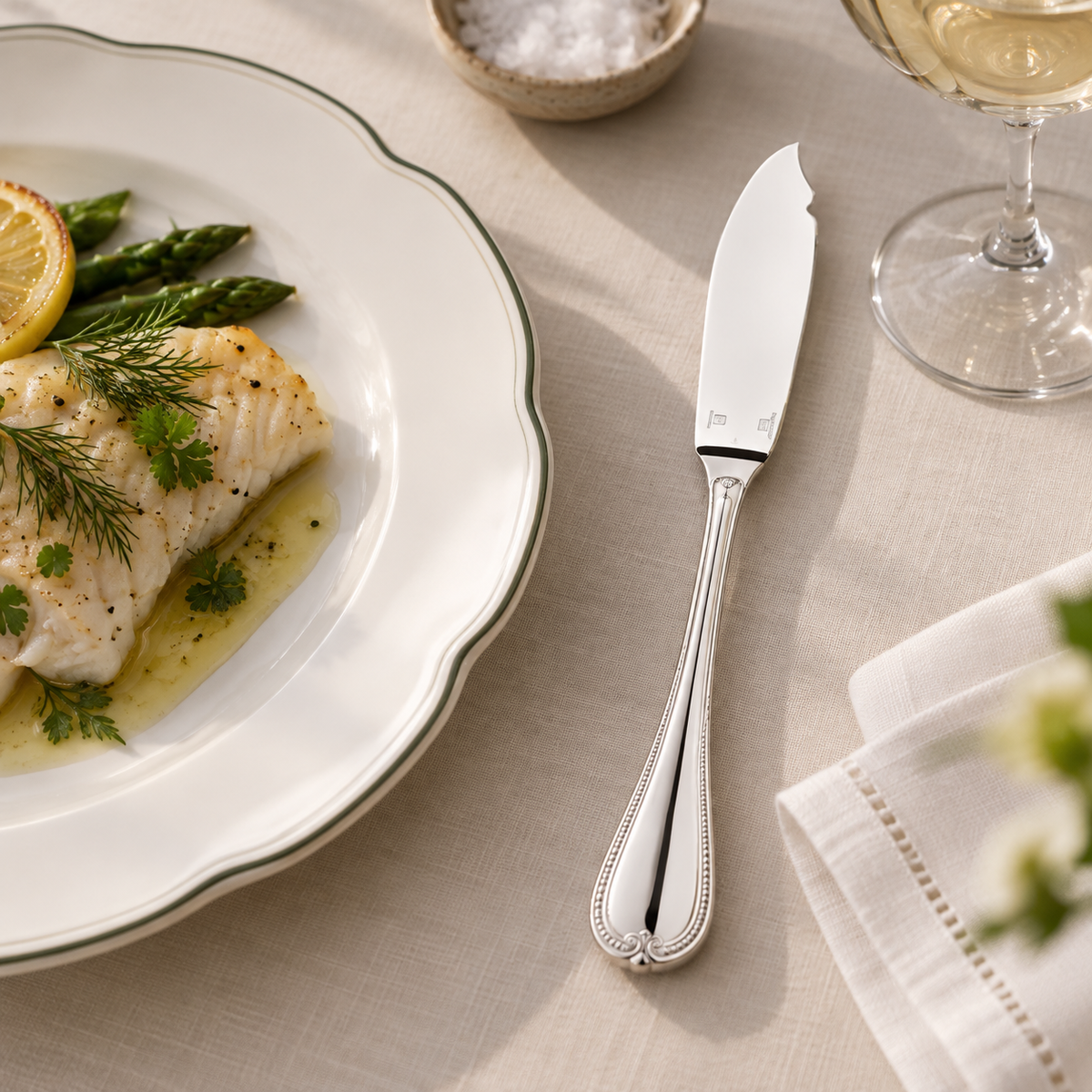
Every feature has a job. The blade is wide so it can slide under a fillet and lift it in one piece. The edge is dull because cooked fish needs no force; a sharp edge would shred the flesh instead of separating it along its natural flakes. The pointed tip, and the notch just behind it on many patterns, catches pin bones and lifts the spine. A modern fish knife runs about 8 to 9 inches long.
The fish fork is shorter than a dinner fork, with a wider left tine, often notched, that works with the knife like a pair of tongs.
The design is a Victorian invention. The fish knife grew out of the 18th century fish slice, a serving tool, and appeared at place settings in Britain in the first half of the 19th century. Before that, even aristocratic diners ate fish with two forks, or one fork and a piece of bread.
From the shop: Set a fish knife beside a dinner knife from the same Christofle pattern and the difference explains itself. One is narrow and edged, built to press. The other is broad and flat, built to lift. Customers who pick up both usually understand the fish knife in a few seconds, without a word from us.
How to hold a fish knife: the grip most guides get wrong
You'll find two conflicting instructions online. Some guides tell you to hold the fish knife like a dinner knife, index finger pressed along the top. The traditional etiquette sources say hold it like a pencil, between the thumb and the first two fingers.
The pencil grip is correct, and the reason is simple: the index-finger grip exists to push down, and with fish you never push down. Holding it like a pencil keeps your touch light and lets you angle the blade flat, almost parallel to the plate, which is the angle you need to slide under a fillet.
The fork stays in the left hand, tines down, as in Continental style. It anchors the fish while the knife separates it.
How to use the fish fork
The fork does more than hold the fish still. Its shape is built for four jobs.
Anchoring. Hold it in your left hand, tines down, and pin the fillet lightly while the knife lifts a flake away. The tines should hold the fish without pressing through to the plate.
Catching bones. The wider left tine, notched on many patterns, is there to hook the pin bones and small bones the knife exposes. Lift them with the notch and set them on the rim of your plate or the bone plate.
Eating. Bring each bite to your mouth on the back of the fork, tines down, Continental style, using the flat of the knife to help load it. Keep the fork in your left hand throughout; there's no switching.
Eating with the fork alone. When the fish is boneless and tender, set the knife aside, move the fork to your right hand and turn the tines up. Use the side of the fork to separate a bite, then lift it. This is perfectly correct, not a shortcut.
How to use a fish knife, step by step
- Anchor the fillet with the fork at its far edge.
- Find the seam. Cooked fish separates into natural flakes; slide the knife's tip into the nearest one.
- Lift, don't slice. Tilt the blade sideways to open the flake away from the fillet.
- Guide the piece onto the fork with the flat of the blade.
- Add sauce with the blade. If there's sauce on the plate, lift a little onto the bite. Don't drag the fish through it.
- One bite at a time. Separate as you go, not the whole fillet at once.
Dish by dish: what the knife actually does
Most guides stop at "a fillet." Real dinners aren't that tidy. Here's what the knife does with what's actually on the plate.
Skinless fillet (halibut, sole, cod). Flake and lift as above. If it's very tender, the fork alone is fine; this is what's often called American style.
Skin-on fillet (salmon, branzino, sea bass). Slide the blade flat between the skin and the flesh and lift the flesh off. Leave the skin on the plate; eating crisped skin is fine at home, but at a formal table it stays behind.
Whole fish on the bone (dorade, Dover sole, trout). Run the knife along the line of the spine to open the top fillet, and lift it off in sections. Then, rather than turning the fish over, slide the knife under the backbone at the tail end, lift the whole skeleton with knife and fork, and set it on the bone plate or the rim of your plate. The bottom fillet is now free.
Fish steaks (tuna, swordfish). These are dense enough that the fish knife struggles. If you're hosting, set a regular dinner knife for these.
Crudo, carpaccio, smoked salmon. Fork only. The knife can help fold a slice onto the fork, nothing more.
Shellfish. Scallops and shrimp: the fish knife works well. Lobster, crab and mussels come with their own tools, and the fish knife stays put.
From the shop: When customers buy fish flatware from us, they usually have a specific dinner in mind, and it's rarely a weeknight salmon fillet. It's a whole roasted fish brought to the table, a holiday menu with a proper fish course, or a dinner they want guests to remember. That's the meal where the fish knife earns its place.
When you find a bone in your mouth
It happens even at the best tables. Don't spit it into your napkin. Remove it discreetly with your thumb and index finger, or bring it back onto the fork, and place it on the rim of your plate or the bone plate. Then carry on.
If you're left-handed
None of the etiquette guides mention this, but it comes up at every dinner party. Swap hands: knife in the left, fork in the right. Because the fish knife never applies force, there's no real disadvantage to switching. If you're the host and know a guest is left-handed, mirror their setting, with knives on the left and forks on the right. It's a small courtesy that guests notice.
Where the fish knife sits in a place setting
Flatware is used from the outside in, in the order courses arrive. The fish course comes before the main, so:
- Right of the plate, working outward: dinner knife, then fish knife, then soup spoon. Blades face the plate.
- Left of the plate, working outward: dinner fork, then fish fork.
If fish is the main course, the fish knife and fork take the place of the dinner knife and fork, closest to the plate.
Resting and finished positions
- Pausing: rest the knife and fork on the plate in an inverted V, tips toward the center, knife blade facing in.
- Finished: place them side by side, handles at roughly four o'clock, tips at ten. That tells the server to clear.
Never rest a used knife back on the tablecloth.
No fish knife at the table? You have three options
- Fork only. For boneless, tender fish, this is perfectly correct.
- Two forks. This is how fish was eaten before the fish knife existed: one fork to separate, one to eat.
- The dinner knife, used lightly. Turn it slightly and use it the way you'd use a fish knife: to separate and push, never to saw.
Are fish knives old-fashioned?
It's a fair question, and the history is more interesting than most guides let on. Fish knives were originally expensive silver pieces, and once electroplating made them affordable by the 1860s, owning a set signaled the comfortable middle class. Old aristocratic families, whose silver predated the invention, pointedly did without them. The poet John Betjeman mocked fish knives as social climbing in 1958, and the Buckingham Palace collection reportedly doesn't include a single one.
In the United States that snobbery never really landed. Here, a fish knife and fork say something simpler: the host planned a fish course. They are the most practical specialized flatware there is, because the shape genuinely does the job better than a dinner knife.
From the shop: We've sold tabletop in Brooklyn since 2006, and fish sets tend to go to three kinds of buyers: couples building a registry, collectors completing a Christofle pattern they've owned for years, and hosts who fell for a long seafood lunch on the Mediterranean and want to bring it home. None of them has ever described it as pretentious. They describe it as finishing the table.
Lemon, fish, and silver: the care problem nobody mentions
Silver became the standard material for fish flatware partly because, before stainless steel, it was the one metal that didn't give lemon and fish a metallic taste. The irony is that citrus and salt are hard on silver plate. Christofle's own care instructions say to avoid citrus.
The fix is timing, not avoidance. Serve the lemon. Then, after dinner:
- Rinse the fish flatware before anything else gets cleared, so lemon juice and salty sauce don't sit on the silver.
- Hand wash with a soft sponge and a mild, chlorine-free detergent.
- Dry immediately with a soft cloth. Water spots and lingering moisture are what start tarnish.
- Store pieces so they don't touch stainless steel.
From the shop: When customers bring us silver fish forks that have spotted or dulled, the cause is almost always the same: lemon juice left to dry on the tines overnight, or a run through the dishwasher next to stainless steel. Five minutes of care the same evening prevents both.
Choosing a set: what it actually costs per place
Fish flatware is sold in sets, so it helps to think per guest. Each guest needs one knife and one fork. The serving set is only needed if you'll portion a whole fish at the table.
Per guest means one fish knife and one fork. Both patterns are silver-plated and made in France by Christofle.
From the shop: If you're starting fresh, or mixing with stainless flatware you already own, we usually point people to Albi; its clean lines sit comfortably beside modern pieces. If you already set the table with traditional silver or heirloom china, Malmaison will look like it was always part of the collection.
Christofle Albi
Architectural lines taken from the cathedral in the French town of Albi.


Christofle Malmaison
Named for Napoleon and Josephine's residence outside Paris, and one of Christofle's most historic patterns. The serving knife has an openwork blade, made for portioning a whole fish at the table.


Frequently asked questions
Is a fish knife sharp?
No. It's deliberately dull. It separates cooked fish along its natural flakes rather than cutting through it.
Which hand holds the fish knife?
The right hand, held like a pencil, with the fork in the left. Left-handed diners can switch.
What is a fish fork?
It's the fork set for the fish course, placed on the left of the plate beside the dinner fork. It's used together with the fish knife to separate fish from skin and bone and lift each bite.
What does a fish fork look like?
It's shorter than a dinner fork, usually with four tines, and the left tine is wider than the others, often with a small notch for catching bones. The Albi and Malmaison fish forks above show the shape clearly.
How do you hold a fish fork?
In your left hand, tines down, with your index finger resting along the back of the handle. If you're eating with the fork alone, it moves to your right hand with the tines up.
Do you turn a whole fish over?
No. Eat the top fillet, then lift the backbone off with the knife and fork to reach the bottom fillet.
Can I use a fish knife for anything else?
It works well for any soft food that needs separating rather than cutting, but at a formal table it is set only for the fish course.
What's the difference between a fish knife and a butter knife?
A butter knife is shorter with a rounded tip, for spreading. A fish knife is longer, with a wide blade, a pointed tip and often a notch for lifting bones.
FOR MORE ENTERTAINING IDEAS, VISIT US ON INSTAGRAM @PARCIPARLAHOME.